Archaeologists usually find pottery in pieces. This project tries to rebuild a whole pot from a single broken fragment.
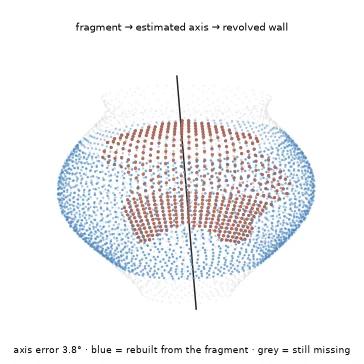
The key observation: most wheel-thrown pots are close to surfaces of revolution. So one sherd carries a lot of information. Estimate the pot's symmetry axis from the fragment, spin the fragment around it, and you get the wall at every height the fragment covers. A learned point-cloud model then fills in only the heights the fragment never reaches.
Finding the axis
Every normal line of a surface of revolution crosses its axis. So the fragment's own face normals point at the axis, and the axis is estimated from where they meet. Revolving the fragment around it and resampling gives the geometric part of the reconstruction.
Results so far
I tested on simulated breakage of digital vessel scans, with a sealed held-out set of 81 vessels:
- The hybrid cut missing-section error by 20.6% compared with the learned model alone (0.187 vs 0.235).
- It also beat geometry alone (0.289).
It can still fail when the axis estimate is off (errors up to 75° on hard fragments) or when the vessel isn't symmetric.
From scans to fragments
To work on real sherds, an intake pipeline turns a 3D scan into a clean fragment: it loads OBJ, PLY or STL files, welds and decimates the mesh, separates the walls from the break faces, and orients the piece upright.
What's next
- Scan real sherds and run them through the intake pipeline.
- Publish a cleaned-up model and an evaluation that runs on openly licensed scans. Several of the source scans have licenses that don't allow redistribution, so the trained model and datasets aren't public yet.